

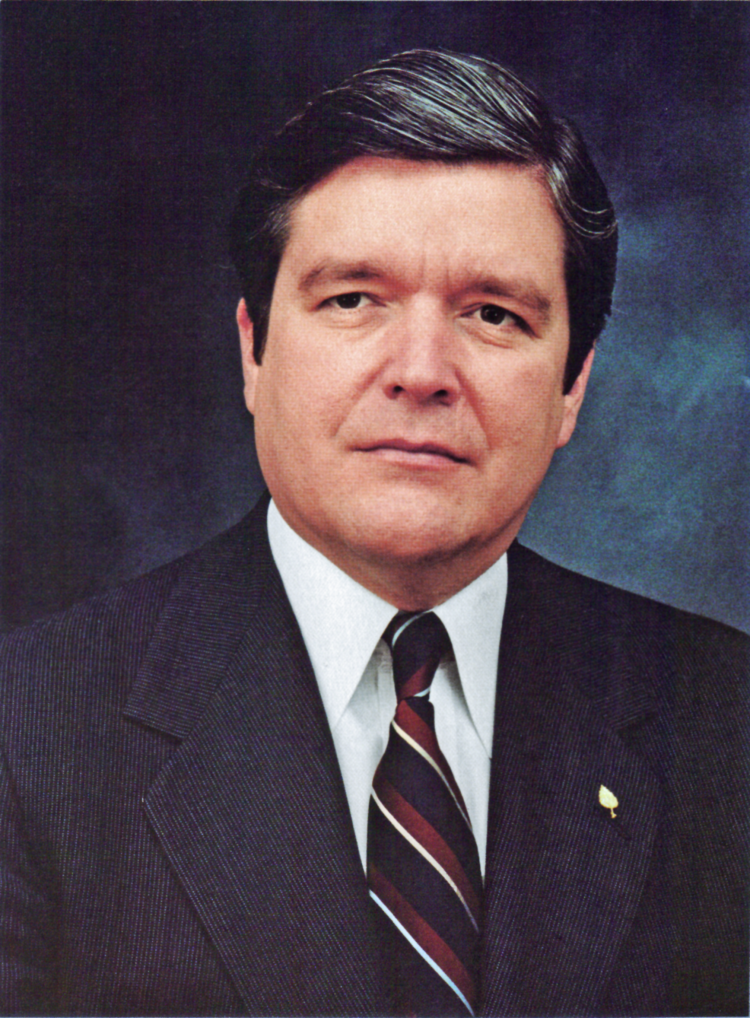
Larry McDonald: Who Was He?
Lawrence Patton McDonald was the second chairman of The John Birch Society, following JBS founder Robert Welch’s promotion to chairman emeritus on March 14, 1983. McDonald held the position of JBS chairman in tandem to serving as a member of the U.S. House of Representatives, representing Georgia’s 7th Congressional District.
Congressman McDonald’s tenure both in Congress and as chairman of the Society was cut short when the commercial airline flight he was traveling aboard, Korean Air Lines 007, was reportedly shot down by a Soviet Sukhoi Su-15 interceptor over Sakhalin Island on September 1, 1983.
McDonald was born in Atlanta, Georgia, on April 1, 1935 to Harold McDonald, Sr. and Callie Grace Patton, a cousin of U.S. Army General George S. Patton. Following the tradition of his father and grandfather, Larry pursued a career in medicine as an urologist. In 1953, he graduated and completed his pre-medical training from Davidson College and was then accepted into Emory Medical School, just prior to his 18th birthday. Upon graduating from Emory in 1957, Larry McDonald became the second-youngest physician in Georgia state history at the age of 22. His father Harold was the youngest physician in the state’s history.
Upon graduation from Emory University, McDonald joined the U.S. Navy, where he served four years in active duty as a physician and flight surgeon. While in the Navy, he interned at the Walter Reed National Military Medical Center in Bethesda, Maryland, and then served as a flight surgeon in Reykjavik, Iceland. By the time he completed his four years of active duty, he had advanced to the rank of lieutenant commander. He continued in the Naval Reserves and eventually rose to the rank of captain.
McDonald continued his medical studies as a resident surgeon at the University of Michigan Hospital in Ann Arbor. During this time, in 1968, McDonald also made his first run for public office, to the Ann Arbor City Council. He openly campaigned as a member of The John Birch Society in the Democratic Party primary, running as a “true” or “historic Democrat,” harkening back to the party roots of Thomas Jefferson, Andrew Jackson, and Grover Cleveland. A staunch constitutionalist, McDonald rejected the New Deal and Great Society unconstitutional big-government policies that defined the mainstream of the Democratic Party.
Although he lost the primary election to the incumbent, an establishment Democrat, he nonetheless gained valuable insight into politics that would prove helpful in his future run for Congress.
In 1967, McDonald became the youngest member elevated to the National Council of The John Birch Society. In March 1983, shortly before his ill-fated flight, he became chairman of The John Birch Society. From the time he became a JBS member, he was a popular lecturer for the Society.
McDonald gave numerous speeches and presentations, covering a range of topics, including the economics of inflation, fiat currency, the history of America’s Founding Fathers and the Constitution, the rise of Bolshevism in Russia, the subsequent spread and threat of international communism, and the Deep State globalist agenda of both the Council on Foreign Relations and the Trilateral Commission.
Through his local leadership as a speaker and organizer for The John Birch Society and its chapters in Cobb County, Georgia, McDonald worked to build an informed electorate. His hard work and diligence paid off when the voters of Georgia’s 7th Congressional District, which included Cobb County, elected him to Congress in 1974.
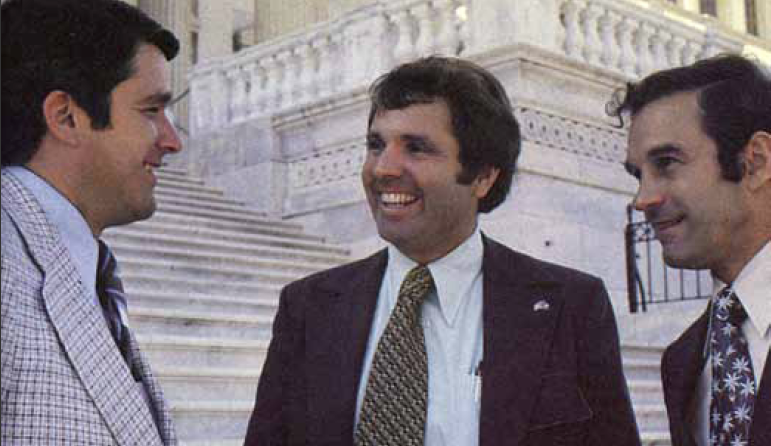
Friends in Congress: Representative Larry McDonald (D-Ga.) talking with two of his closest colleagues in Congress, Senator Steve Symms (R-Idaho; center) and Representative Ron Paul (R-Texas). Representatives McDonald and Paul often voted together and cosponsored each other’s bills.
McDonald’s tenure in the House was characterized by his firm support for sound money (a gold-standard-backed U.S. dollar), U.S. withdrawal from the United Nations, exposing globalist think tanks and tax-exempt foundations, solid anti-communism, countering communist subversion, and exposing Soviet Active Measures including the USSR’s role in backing Marxist guerillas and other leftist terrorist organizations operating in South America, the Middle East, Africa, Europe, and the United States. When it came to voting, McDonald ultimately came to a decision based on the following three-point criteria:
- Is it constitutional,
- Do we need it, and
- Can we afford it?
This filtration process resulted in many “nay” votes and his reputation as one of the most conservative and principled members of Congress. In an interview with The Philadelphia
Inquirer, Congressman Ron Paul (R-Texas) said of Larry McDonald, “He was the most principled man in Congress.” McDonald’s principled stand was reflected in his voting record. Year after year, Larry McDonald scored perfect 100-percent ratings in the “Conservative Index” published by The Review of the News magazine, a forerunner of The New American magazine’s current “Freedom Index.”
In addition to his consistent constitutional credentials in The Review of the News, McDonald also scored remarkably high in other scorecards. In 1982, for instance, he scored a perfect 100-percent rating from the American Conservative Union, Americans for Constitutional Action, Christian Voice, National Alliance of Senior Citizens, National Conservative Political Action Committee, National Chamber of Commerce, and National Federation of Independent Business.
On September 1, 1983, while en route to a meeting in Seoul, South Korea, to deliver a speech about South Korean and U.S. cooperation in the struggle against Soviet-led international communism, his flight KAL 007 was reportedly intercepted and shot down by a Soviet Sukhoi Su-15 fighter over the Sea of Japan, near Sakhalin Island.
In his life, Larry McDonald was recognized for his commitment to advancing and protecting the principles and ideals of liberty outlined in the Constitution; and in his memory neither he nor the knowledge he sought to have others know should be forgotten or rejected.
(This biography is a revised and abridged version of the biographical article by Christian Gomez, entitled, “Larry’s Legacy,” published in the September 23, 2013 issue of The New American magazine.)